
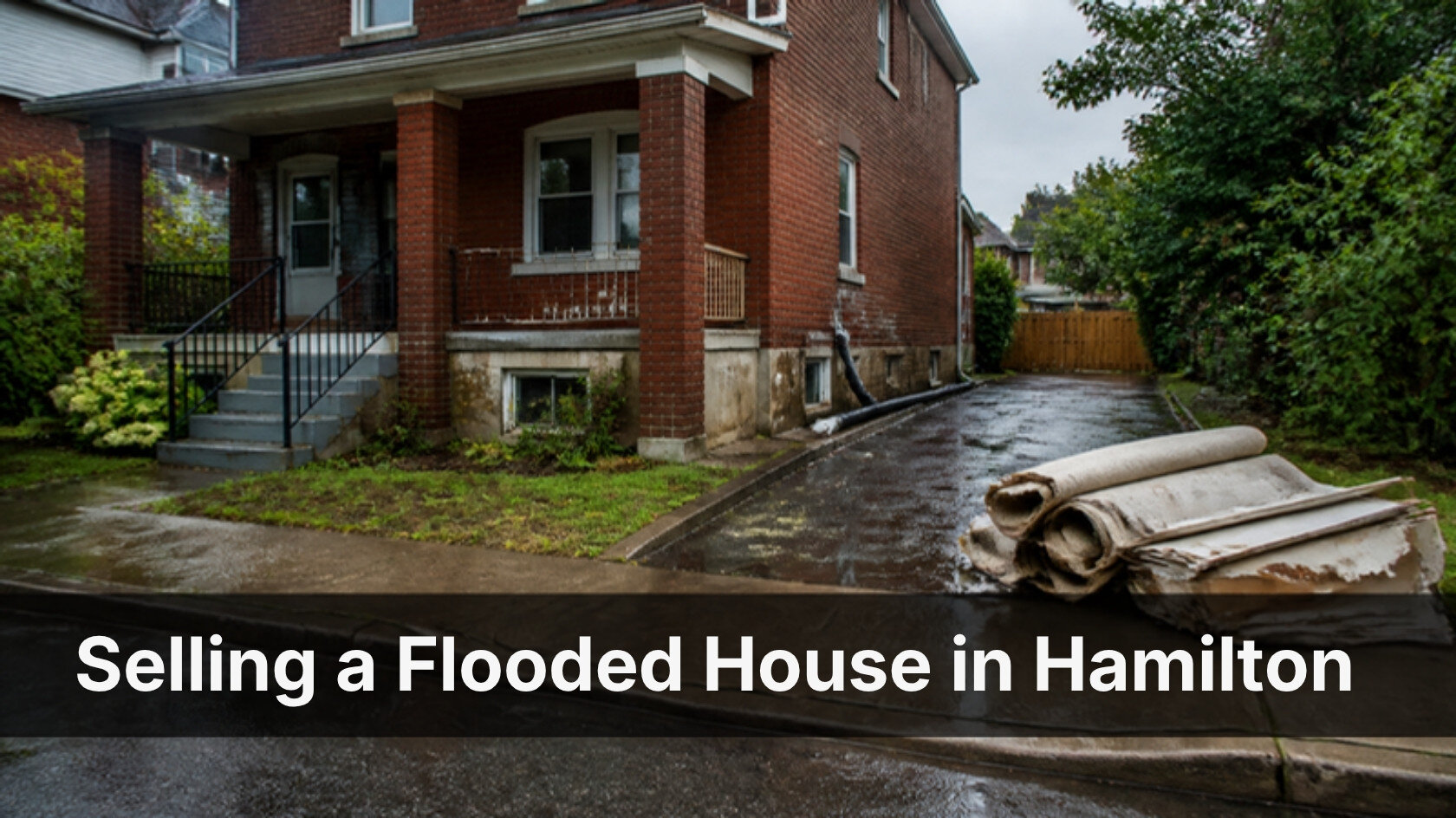
When the Water Goes Down but the Problems Don’t
Hamilton had a rough summer. The City recognized four separate rainstorm events — July 21, July 28, August 2 and August 7, 2026 — as serious enough to set up a one-time compassionate grant for residents whose homes flooded. For a lot of families on the Mountain, in the east end and in older lower-city neighbourhoods, those storms meant sewer water coming up through the floor drain, soaked drywall, ruined furnaces, and a basement that still smells wrong months later.
Some homeowners have the insurance coverage, savings and energy to rebuild. Others are discovering that their policy didn’t include sewer backup or overland flood coverage, that the restoration quote is far bigger than they expected, or that they simply don’t want to keep living with the risk of it happening again. If you’re in that second group and you’re wondering whether you can sell a flooded or water-damaged house in Hamilton without fixing everything first, this guide walks through your real options, what the current market looks like, and how to protect yourself along the way.
What Hamilton’s Market Looks Like Right Now
Before deciding anything, it helps to know what kind of market you’d be selling into. According to WOWA’s analysis of Cornerstone Association of REALTORS® data, the average sold price in the Hamilton region in September 2026 was $714,420 — down 7.9% from a year earlier and 3% from August. Detached homes averaged roughly $779,000, down about 9% year over year.
Supply is climbing too. New listings in the Hamilton region jumped about 26% from August to September while sales stayed roughly flat, the sales-to-new-listings ratio fell to 35%, and there were about 4.8 months of inventory on the market. Homes that did sell took an average of 46 days. Buyers have choices, and they’re being picky.
That matters a lot if your house has visible water damage. In a hot market, buyers will sometimes overlook a damp basement. In a balanced-to-soft market like this one, a home with a flood history, stained drywall or a musty smell tends to sit while buyers tour three other houses down the street that don’t come with a question mark.
Why Water Damage Is So Hard to Sell Around
Water damage isn’t like a dated kitchen. Buyers and their lenders see it as a risk that could keep growing, and that shows up in several ways during a traditional sale:
- Mould concerns. Wet drywall, insulation and carpet that weren’t removed quickly can grow mould behind walls. Home inspectors are trained to look for staining, efflorescence on foundation walls and elevated moisture readings, and many buyers will walk away at the first mention of it.
- Insurance questions. A buyer’s insurer may ask about prior water claims, the presence of a backwater valve, and the age of the sump pump. A home with a recent flood history can be harder or more expensive to insure, which can complicate financing.
- Lender hesitation. If an appraiser notes active damage or an unfinished basement that was gutted after a flood, the lender may lower the valuation or require repairs before funding.
- Renegotiation at the last minute. Even when a buyer is willing to proceed, the inspection often becomes a bargaining tool — with requests for a price reduction equal to (or more than) a contractor’s estimate.
If your home has other issues on top of the water damage — older wiring, an aging roof, or deferred maintenance — those concerns can stack up quickly. Our guide on selling a house that needs repairs in Hamilton covers how buyers typically evaluate a home’s overall condition when a full renovation isn’t realistic.
The Insurance Gap Many Hamilton Homeowners Discovered This Year
One of the most common surprises after a basement flood is finding out what your policy actually covers. As the Insurance Bureau of Canada and industry coverage have pointed out, a standard home insurance policy typically does not cover sewer backup or overland flooding — the two most common causes of a flooded basement. Both are usually optional endorsements that have to be added separately. Groundwater seepage through foundation cracks is often excluded entirely.
The bigger picture isn’t encouraging either. The IBC estimates that insured losses from extreme weather in Canada have averaged more than $3.7 billion a year over the last decade, and a string of thunderstorms across Ontario and Quebec between June 30 and July 3 of 2026 alone caused an estimated $439 million in insured damage. A long-promised federal flood insurance program, which had been targeted to launch in April 2026, has missed that date without a new timeline announced, according to reporting on the IBC figures.
For homeowners, that usually translates into higher premiums, larger water deductibles, and in some cases insurers declining to renew a policy after repeated claims. If you’ve just been through a flood and your renewal letter came back with a big increase — or a non-renewal — that can change the math on whether staying and rebuilding is worth it.
Help Available From the City of Hamilton
Before you make a decision either way, it’s worth knowing what local support exists. Two City of Hamilton programs are especially relevant:
The 2026 Rainstorms Compassionate Grant
The City has set up a one-time compassionate grant of up to $2,000 for eligible homeowners and tenants whose residential properties flooded during the July 21, July 28, August 2 or August 7, 2026 rainstorms. The grant is meant for eligible costs not covered by insurance — clean-up, repairs, replacing essential items like furnaces, washers and dryers, and even your insurance deductible. The amount is based on the lowest of $2,000, your deductible, or your actual eligible costs.
Applications are administered by Sedgwick Canada on the City’s behalf and must be received within 120 days of the storm event. Based on the City’s published schedule, deadlines fall between November 21 and December 7, 2026, depending on which storm affected your home. If you were hit, keep your receipts, invoices and photos, and check the City of Hamilton website for the current details — even if you’re planning to sell, that money can help with clean-up or moving costs.
The Protective Plumbing Program (3P)
Separately, the City’s Protective Plumbing Program offers owners of single-family homes a grant of up to $2,000 toward installing a backwater valve, a sump pump installed with a backwater valve, and downspout disconnection. To qualify for the full amount, you need to use one of the City’s pre-qualified contractors; using an outside contractor caps the backwater valve grant at $500. Eligibility rules include having a basement, being connected to the City sewer system, having property taxes up to date, and a home built before January 1, 2012. A matching loan program of up to $2,000 is also available for costs above the grant.
Your Three Main Options When Selling a Flooded House
Every situation is different, but most Hamilton homeowners dealing with flood or water damage end up choosing one of three paths.
Option 1: Fully restore, then list
This means professional water remediation, mould testing and removal, replacing drywall, flooring and insulation, and possibly repairing the foundation, sump system or plumbing. When it’s done properly, with documentation and permits, you can list the home on the open market and compete with other move-in-ready homes.
The trade-offs are cost, time and uncertainty. Industry estimates for basement flood restoration vary widely — from a few thousand dollars for a quick clean-up to tens of thousands when finished basements, mechanicals and mould remediation are involved. You’ll also be carrying the mortgage, property taxes, utilities and insurance the whole time, and in a market where homes are already averaging about 46 days on market, the clock keeps running after the work is finished.
Option 2: List as-is with a realtor
You can list the home in its current condition and price it to reflect the damage. Some buyers — usually renovators or investors — will look at it, but many conventional buyers won’t, and their lenders may not cooperate. Expect a longer marketing period, a lower final price, conditional offers that fall apart after inspection, and realtor commissions on top.
In Ontario, sellers also need to be careful about disclosure. While there’s no general legal requirement to volunteer every minor issue, sellers generally can’t hide known latent defects that make a home dangerous or unfit to live in, and actively concealing damage — like painting over water stains or covering a cracked foundation — can expose you to legal claims after closing. A real estate lawyer can tell you exactly what applies to your situation.
Option 3: Sell directly to a cash buyer
A direct cash sale means selling the house in its current condition to a buyer who doesn’t rely on mortgage financing, home inspection conditions or a buyer’s insurance approval. You skip the repairs, the showings and the commission, and you can usually pick a closing date that works for you — sometimes in as little as a couple of weeks, or later if you need time to move.
The trade-off is price: a cash buyer is taking on the cost and risk of the restoration, so the offer will reflect that. For many homeowners, though, the certainty of a firm offer and a predictable closing is worth more than chasing a theoretical higher price that might never materialize.
Ready to sell your house fast in Hamilton?
Or call us directly: 647-800-4508
How Cash Buyers Evaluate a Water-Damaged Home
If you’re considering a direct sale, it helps to understand how an experienced buyer actually looks at a flooded property. At Hamilton House Buyers, we generally focus on a few things:
- The source of the water. Sewer backup, overland flooding, a burst pipe, a failed sump pump and long-term foundation seepage all lead to different repair scopes. Knowing what happened helps us estimate what it will take to fix.
- How long the water sat. A basement that was pumped out and gutted within a few days is very different from one that stayed wet for weeks.
- Mechanical systems. Furnaces, water heaters and electrical panels located in the basement are often the most expensive items to replace after a flood.
- Foundation and grading. Cracks, poor lot grading and connected downspouts all affect the risk of future flooding.
- The rest of the house. Roof, windows, wiring and plumbing still matter. A home with water damage plus other deferred maintenance gets evaluated as a whole.
You don’t need answers to all of these, and you don’t need to hire a remediation company or clear out the basement before reaching out. We can walk the property with you and make an offer based on the home as it is.
Practical Steps to Take Right Now if Your Home Flooded
Whether you end up rebuilding, listing or selling directly, these steps protect your options:
- Document everything. Take photos and video of the damage, the water line, damaged belongings and any repairs. Keep every receipt and invoice — you’ll need them for insurance, for the City’s compassionate grant, and potentially for a buyer.
- Call your insurer and get answers in writing. Ask specifically whether you have sewer backup and overland flood coverage, what your water deductible is, and whether the claim will affect your renewal.
- Check grant deadlines. If your home flooded in one of the four recognized 2026 storms, confirm the application deadline for your event with the City of Hamilton.
- Dry the space and stop further damage. Remove standing water, run dehumidifiers and pull out soaked materials if it’s safe to do so. Ongoing moisture is what turns a contained problem into a mould problem.
- Get safety checked. If water reached your electrical panel, furnace or gas appliances, have them inspected by licensed professionals before using them.
- Don’t cover anything up. If you’re thinking about selling, be honest about what happened. Transparency protects you legally and builds trust with any buyer.
When Selling Makes More Sense Than Rebuilding
There’s no single right answer, but in our experience homeowners in Hamilton often decide to sell instead of rebuilding when:
- The restoration estimate is more than they can afford, or more than insurance will cover.
- Their insurer has raised premiums sharply, increased the water deductible, or declined to renew.
- The home has flooded more than once and they no longer feel safe storing anything in the basement.
- They’re managing the home for a parent or an estate and don’t want to oversee a months-long renovation.
- The flood came on top of another life change — a job loss, a separation, a health issue — and they simply need a clean, predictable exit.
Water damage often overlaps with other kinds of property damage, too. If your home was also affected by a fire or smoke event, our article on selling a fire-damaged house in Hamilton explains how that process works. And if your insurer has raised concerns about other systems in the house, like older electrical, our guide to selling a house with knob-and-tube or aluminum wiring in Hamilton covers that insurance angle in more detail.
Frequently Asked Questions
Can I sell my house in Hamilton if the basement flooded and hasn’t been repaired?
Yes. You can list it as-is with a realtor or sell it directly to a cash buyer. Unrepaired water damage usually narrows your pool of conventional buyers, so a direct sale to a buyer who purchases homes in any condition is often the fastest route.
Do I have to tell buyers my house flooded?
In Ontario, sellers generally must not conceal known latent defects that make a home dangerous or unfit to live in, and misrepresenting a property’s condition can lead to legal claims after closing. Being upfront about a flood is the safest approach. A real estate lawyer can advise on your specific disclosure obligations.
Will a cash buyer require a mould inspection first?
Not usually. An experienced cash buyer will assess the property themselves and factor potential mould remediation into their offer. You don’t need to pay for testing or remediation before getting an offer.
Does home insurance cover basement flooding in Ontario?
It depends on your policy. Standard home insurance typically doesn’t cover sewer backup or overland flooding unless you’ve added those specific endorsements. Groundwater seepage is often excluded. Check your policy wording and ask your insurer to confirm coverage in writing.
Can I still apply for the City’s flood grant if I’m selling the house?
The City of Hamilton’s 2026 Rainstorms Compassionate Grant is aimed at eligible costs not covered by insurance for affected residential properties, with application deadlines 120 days after each recognized storm. Eligibility rules apply, so contact the City’s administrator, Sedgwick Canada, to confirm whether your situation qualifies before you sell.
How much less is a flood-damaged house worth?
There’s no fixed percentage. The value depends on the extent of the damage, the cost to repair it, the home’s location and condition otherwise, and current market conditions. With Hamilton’s average price around $714,000 in September 2026 and inventory rising, buyers are price-sensitive, which makes an honest repair estimate especially important.
How fast can I sell a water-damaged house to Hamilton House Buyers?
Once we’ve seen the property and you’ve accepted an offer, closing can often happen in as little as a couple of weeks, depending on title and lawyer timelines. If you need more time, we can set a later closing date.
Final Thoughts
A flooded basement is stressful enough on its own. When it comes with an insurance gap, a big restoration quote, or the worry that it could happen again with the next heavy storm, it’s completely reasonable to ask whether rebuilding is really your best move. Hamilton’s market has softened, inventory is rising, and buyers are being cautious — which makes it harder than ever to sell a water-damaged home the traditional way.
Start by documenting the damage, getting clear answers from your insurer, and checking whether you qualify for the City’s compassionate grant or the Protective Plumbing Program. Then compare your options with real numbers. If you’d rather skip the repairs, the showings and the uncertainty, Hamilton House Buyers can give you a fair, no-obligation cash offer on your home exactly as it is — and let you choose the closing date that fits your next step.