
Selling a Hamilton Home with Unpermitted Work: What Nobody Tells You
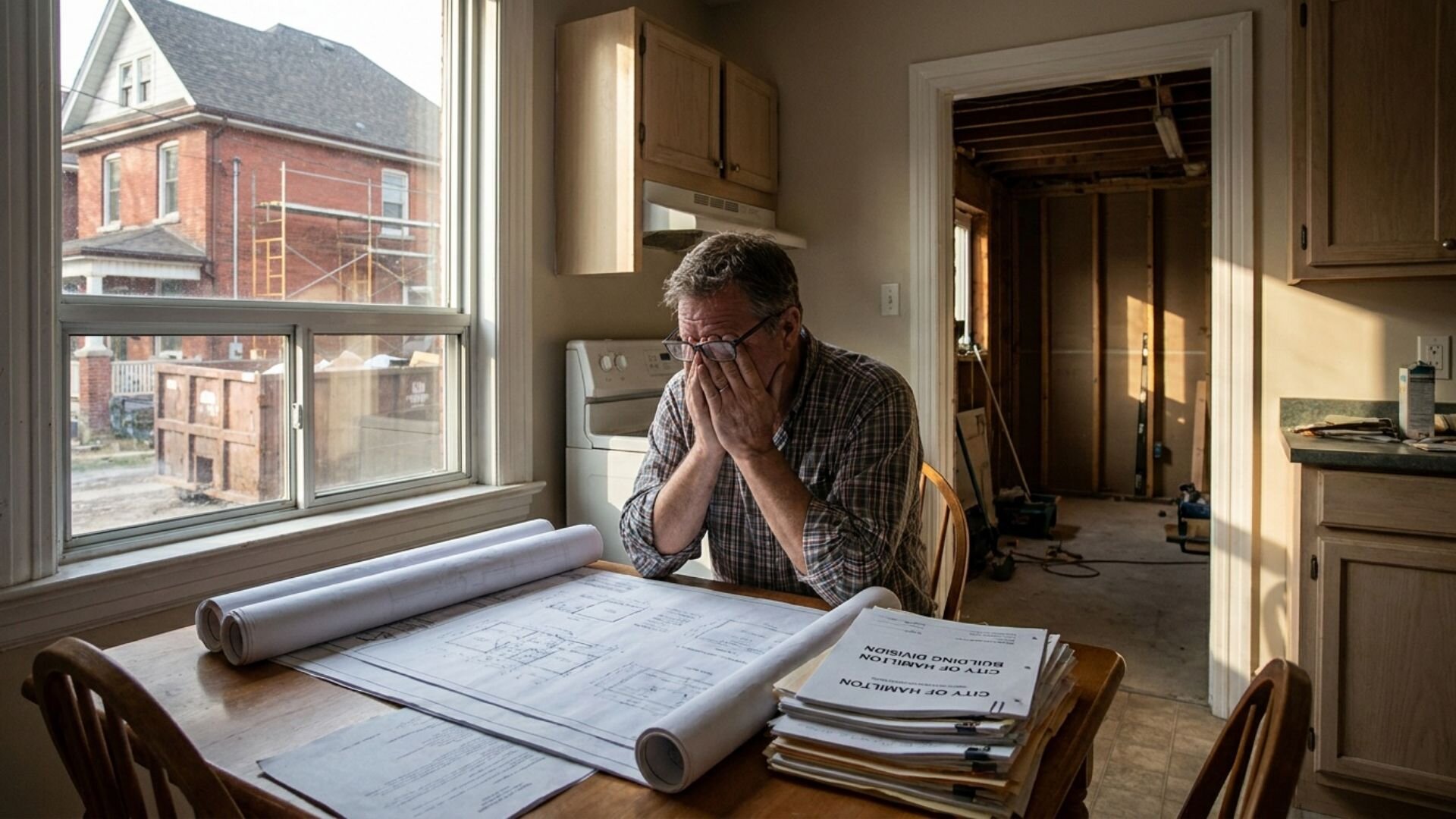
You finished your basement. You added a bedroom above the garage. You converted the carport into a proper enclosed space. Maybe a previous owner installed a second kitchen downstairs, and you never thought much about it — until now, when you’re trying to sell.
If your Hamilton home has unpermitted work or renovations, you’re not alone — and you’re not out of options.
Every week I speak with homeowners across Hamilton, from the older brick semis along Barton Street East to the postwar bungalows in Eastmount and the split-levels in Greeningdon, who are sitting on properties that have been renovated over the decades without the proper City of Hamilton permits. Sometimes the work was done by a previous owner thirty years ago. Sometimes it was a DIY weekend project that spiralled. Sometimes a well-meaning contractor said “don’t worry about permits — it’s just a small job.”
The problem only becomes visible when it’s time to sell.
This guide will explain exactly what unpermitted work means in Hamilton, why it complicates a traditional sale, what your legal obligations are as a seller, and — most importantly — how you can still sell your home quickly and without putting yourself at legal or financial risk.
What Counts as “Unpermitted Work” in Hamilton?
The City of Hamilton requires homeowners to obtain a building permit for most structural, electrical, plumbing, and mechanical work. This includes, but is not limited to:
- Finished basements (especially those with separate entrances, kitchens, or bathrooms)
- Additions to the footprint of the home
- New or relocated plumbing (adding a bathroom, moving a kitchen sink)
- Electrical panel upgrades or rewiring
- New windows or doors that change the size of existing openings
- Structural changes like removing load-bearing walls
- Decks over 600mm (about 24 inches) above grade
- Detached garages and accessory structures over 10 square metres
- Converting a garage or carport into living space
- Adding a secondary suite (basement apartment)
If any of these were done without pulling a permit — meaning no City inspector ever signed off on the work — it is classified as unpermitted. In older Hamilton neighbourhoods like Crown Point, Stipley, Gibson, Raleigh, and Landsdale, it is remarkably common to find basements finished in the 1970s or 1980s with zero documentation.
Why Unpermitted Work Makes a Traditional MLS Sale Difficult
When you list a home on the MLS through a real estate agent in Hamilton, unpermitted work creates several serious complications.
1. Disclosure obligations under Ontario law. Under Ontario’s Real Estate and Business Brokers Act and the general principles of real property law, sellers are legally required to disclose known material defects. Unpermitted work that you are aware of is considered a material fact. If you disclose it, it must appear on the listing, which will immediately reduce buyer interest and your negotiated price. If you don’t disclose it and a buyer discovers it after closing, you may face legal action.
2. Mortgage financing complications. Most buyers in Hamilton need a mortgage. When a lender’s appraiser visits the property, they flag unpermitted square footage. Banks and credit unions will often refuse to lend against finished basement space that doesn’t appear in City records. This means buyers using conventional financing may be unable to complete a purchase — or they’ll insist you either remedy the permits before closing (expensive and time-consuming) or reduce the price to reflect that the space has no official value.
3. Home insurance issues. A buyer’s insurance company may refuse to insure the property or may exclude certain areas from coverage if there is unpermitted construction. A fire in an unpermitted basement apartment, for example, could result in a denied claim.
4. The permit-retroactive application process is slow and uncertain. Some homeowners explore “after-the-fact” permit applications through the City of Hamilton. This process requires an inspection, often requires opening walls to verify insulation, wiring, and framing, and may require bringing older work up to current Ontario Building Code standards. In my experience working with Hamilton homeowners, a retroactive permit application can take months and cost anywhere from a few thousand to tens of thousands of dollars — especially if the inspector finds deficiencies.
For a homeowner who is already financially stretched, facing a health crisis, dealing with the aftermath of a separation, or simply needs to move quickly, none of these options are realistic.
That’s where selling as-is to a cash buyer becomes the most practical path forward.
The Hamilton-Specific Problem: Older Homes and DIY History
Hamilton’s housing stock is among the oldest in Ontario. The lower city — bounded roughly by the Escarpment to the south and the harbour to the north — is filled with homes built between the 1890s and the 1960s. These properties have changed hands many times. Many have been modified in ways that made sense at the time but were never formally permitted.
Take the Beasley neighbourhood, just east of downtown. Walk down any street and you’ll find century-old workers’ cottages that have had basement suites added in the 1980s, rear additions built in the 1990s, and kitchen moves done by contractors who may not have suggested permits were necessary. In the North End, near the waterfront, similar stories play out in the brick two-storey homes that housed steelworkers’ families for generations.
Out in the Mountain neighbourhoods — Raleigh, Lawfield, Rolston, Bonnington — the postwar bungalows are frequently “finished below” by previous owners who turned cold concrete floors and drywall into family rooms, hobby spaces, and in-law suites. Permits for those jobs from 1975 may simply never have existed.
If you’re trying to sell one of these homes today, the unpermitted work problem isn’t a reflection of anything you did wrong. It’s simply the reality of owning an older Hamilton property.
Your Legal Obligations as a Seller
This is the section most people want to skip over, but I want to be direct with you: you must disclose unpermitted work that you know about.
Ontario’s rules on seller disclosure are based on the principle of caveat emptor — “let the buyer beware” — but with significant carve-outs. While sellers are not legally required to hunt for defects they don’t know about, they are legally required to disclose known material defects. A material defect is anything that would affect a reasonable buyer’s decision to purchase or the price they would pay.
Unpermitted structural work, an illegal basement suite, or a removed load-bearing wall with no permit clearly falls into this category.
If you sell through the MLS and fail to disclose, you expose yourself to post-closing litigation. Buyers have successfully sued sellers in Ontario for failing to disclose unpermitted work discovered after purchase. The costs of defending such a lawsuit, even if you win, can be devastating.
The good news: when you sell to a professional cash buyer like Hamilton House Buyers, the disclosure process is straightforward and doesn’t result in your deal falling apart. We assess the property as-is, account for the unpermitted work in our offer, and move forward without conditions. There is no financing condition, no bank appraiser, and no insurance underwriter who needs to sign off. You disclose what you know, we price it appropriately, and you move on.
Ready to sell your house fast in Hamilton?
Or call us directly: 647-800-4508
What Happens to the Price When There’s Unpermitted Work?
This is the honest conversation most sellers don’t want to have, but it’s the one that matters most.
Unpermitted work does affect the value of your home — but the penalty is often far less severe when you sell to a cash buyer than when you try to force through a traditional MLS sale.
On the MLS, a disclosed unpermitted basement suite might cause 15–25% of buyers to eliminate your property immediately. Those who remain will negotiate aggressively. They know you have limited options. Their offers will include price reductions to cover the cost of permits and potential remediation, financing conditions that are likely to fall through, and inspection conditions that open the door to further negotiation.
With a cash buyer, the calculus is different. We’re not financing the property, so there’s no bank appraiser flagging the issues. We assess the property holistically — the unpermitted work is one factor among many, including location, condition, lot size, and comparable sales in your neighbourhood. Our offer reflects reality, and we don’t change the terms at the last minute.
Many of the Hamilton homeowners I’ve worked with have told me they received more in net proceeds from a cash sale — even at a slightly lower face price — than they would have after agent commissions, staging costs, carrying costs during a prolonged MLS listing, and the price concessions that come with a conditional offer from a financed buyer.
If you’re also dealing with other property condition issues alongside the unpermitted work, our post on selling a distressed property in Hamilton covers the full picture of what cash buyers look for and how offers are structured.
The Retroactive Permit Process in Hamilton: A Reality Check
Before we go further, let’s walk through what it actually looks like to pursue an after-the-fact permit in Hamilton — because some sellers want to explore this option before deciding to sell as-is.
Step 1: Contact the City of Hamilton Building Division. You’ll need to submit a permit application for the work that was done. This requires submitting drawings or sketches that show the work, along with the applicable permit fee (which is based on the value of the construction).
Step 2: Inspection. An inspector will visit the property to assess whether the work complies with the Ontario Building Code. For work that is concealed — inside walls, under floors — the inspector may require you to open those areas to verify wiring, insulation, and structural members. This alone can cost thousands of dollars in drywall removal and reinstallation.
Step 3: Remediation. If the work doesn’t meet code (and work from the 1970s, ’80s, or ’90s frequently doesn’t meet today’s standards), you’ll be required to bring it up to code before the permit is closed. This might mean upgrading knob-and-tube wiring, adding proper egress windows to a basement bedroom, installing a second means of egress from a basement suite, or improving fire separation between units.
Step 4: Time. The City of Hamilton’s building department is busy. Processing times for permits and inspections can stretch from several weeks to several months. If you need to sell in the near term, this timeline may simply not work.
I’ve seen Hamilton homeowners spend $18,000 to $35,000 bringing older basement work up to code — and then still receive MLS offers that reflected the property’s condition, not the investment they made. For most sellers in difficult situations, this math simply doesn’t add up.
How Hamilton House Buyers Handles Unpermitted Work
When you reach out to Hamilton House Buyers, here’s what the process looks like for a property with unpermitted work:
Initial call. We talk through what you know about the property. What work was done, when, by whom, and whether you have any documentation (old photos, contractor invoices, anything that shows the work’s age and quality). You don’t need to have everything figured out — this is a conversation, not an interrogation.
Property walkthrough. One of us will come see the home. We look at the property as a whole: the neighbourhood, the lot, the condition of the structure, and yes, the unpermitted work. We’re experienced enough to assess what we’re looking at without requiring you to open walls or pay for inspections.
Written offer within 24–48 hours. We provide a written, no-obligation cash offer that reflects the property’s real value in its current state. If the basement has an unpermitted suite, we’ve factored that in. There are no surprise deductions at closing.
Flexible closing. We close on your timeline — as fast as two to three weeks if you need it, or longer if you need time to make arrangements.
No commissions. No repairs. No permits. You don’t pay a real estate agent’s commission (typically 4–5% in Hamilton), and you don’t spend a dollar on permits or remediation. What we offer is what you receive, minus your lawyer’s closing costs.
We’ve purchased homes all across Hamilton — from properties on Ottawa Street North with old basement workshops that were converted into secondary suites, to bungalows in Huntington Park with garage conversions, to century homes on the east Mountain with additions that were built before anyone thought much about permits. The unpermitted work doesn’t scare us. It’s part of Hamilton’s housing story.
Common Situations We See in Hamilton
To give you a sense of how common this is, here are some of the most frequent scenarios we encounter:
The undisclosed second suite. A previous owner added a basement apartment — a second kitchen, a separate entrance, a bathroom — without permits. The current owner has been renting it out or has it as family space. The City of Hamilton classifies this as an illegal secondary unit because it was never permitted or inspected for safety.
The finished basement without permits. Drywall, pot lights, a bathroom, and a bedroom — all done by a contractor who never mentioned permits. The homeowner assumed everything was above board. It wasn’t.
The garage conversion. Common in Mountain neighbourhoods and suburban areas like Binbrook and Glanbrook, where a single-car or double-car garage was enclosed and converted to a playroom, home office, or workshop. These almost never have permits.
The older addition. A rear addition built in the 1970s that added a family room or extra bedroom. The addition may be fully functional, but there are no permits on file with the City.
The panel upgrade. Previous owners upgraded from 60-amp to 200-amp service without pulling an electrical permit. The work may be fine electrically, but without the permit and ESA (Electrical Safety Authority) certificate, it’s a flag for buyers and mortgage lenders.
In all of these situations, selling to a cash buyer is almost always the fastest, lowest-risk path to closing. If you want to understand more about the agent-versus-cash buyer comparison, our post on selling your Hamilton home without a realtor lays out the tradeoffs honestly.
Frequently Asked Questions
Do I have to tell a buyer about unpermitted work in Ontario?
Yes. If you are aware of unpermitted work, you are legally required to disclose it as a known material defect under Ontario real property law. Failing to do so can expose you to lawsuits after closing. The disclosure requirement applies regardless of whether you sell through an agent or directly to a buyer.
Can I sell my Hamilton home as-is with unpermitted work?
Absolutely. There is no law that prevents you from selling a home with unpermitted work. The key is proper disclosure. When you sell to a cash buyer like Hamilton House Buyers, we purchase properties as-is and account for the unpermitted work in our offer, so you don’t need to remedy anything before closing.
Will the City of Hamilton penalize me if I sell without fixing unpermitted work?
The City of Hamilton enforces building code compliance primarily through complaint-driven processes and permit applications. Simply selling the home without retroactively permitting the work does not automatically trigger a City order to comply — though if someone files a complaint, it could. Once you sell and transfer title, the obligation and any future enforcement typically transfers to the new owner. A cash buyer who purchases as-is assumes that risk.
How much will unpermitted work reduce my home’s value?
It depends on the nature and extent of the work, the current Hamilton market, and the type of buyer. On the MLS with a traditional agent, the discount can be substantial — often 10–20% below what the property would fetch if fully permitted, plus the carrying costs and risk of deals falling through. With a cash buyer, the discount is generally smaller because we’re not dealing with financing conditions, appraiser flags, or insurance issues.
What if the unpermitted work was done before I bought the house?
This is very common in Hamilton, where homes change hands frequently. If you discovered the unpermitted work after you bought the home, you still have disclosure obligations when you sell — you must disclose what you know. If the previous seller failed to disclose it to you when you bought, you may have a claim against them, but that’s a separate matter. An experienced real estate lawyer in Hamilton can advise you on your options.
Can I get a retroactive permit for work done decades ago?
Yes, in most cases the City of Hamilton will allow retroactive permit applications for older work. However, the process requires the work to meet current Ontario Building Code standards, not the standards in effect when the work was done. That often means significant upgrades are required. For work done in the 1970s or 1980s, this can be costly and complex.
How fast can I sell if I don’t want to deal with permits?
With Hamilton House Buyers, the process from initial call to signed offer is typically 24–48 hours. Closing can happen in as little as two weeks, or on whatever timeline works for you. There are no conditions, no bank appraisals, and no permit requirements.
Final Thoughts: You Don’t Have to Fix Everything Before You Move On
If you’ve been holding off on selling your Hamilton home because of unpermitted work — anxious about what an agent will say, worried about legal exposure, unsure how much it will cost to fix — I want you to hear this clearly: you have a way forward that doesn’t require months of permit applications, thousands of dollars in renovations, or the uncertainty of a conditional MLS offer.
Unpermitted work is one of the most common challenges we help Hamilton homeowners navigate. It doesn’t have to be the thing that keeps you stuck.
Reach out to us today and let’s have an honest conversation about your home and your situation — no pressure, no judgment, just real answers.
Hamilton House Buyers 📞 647-800-4508
No pressure. No obligation. Just honest answers.