
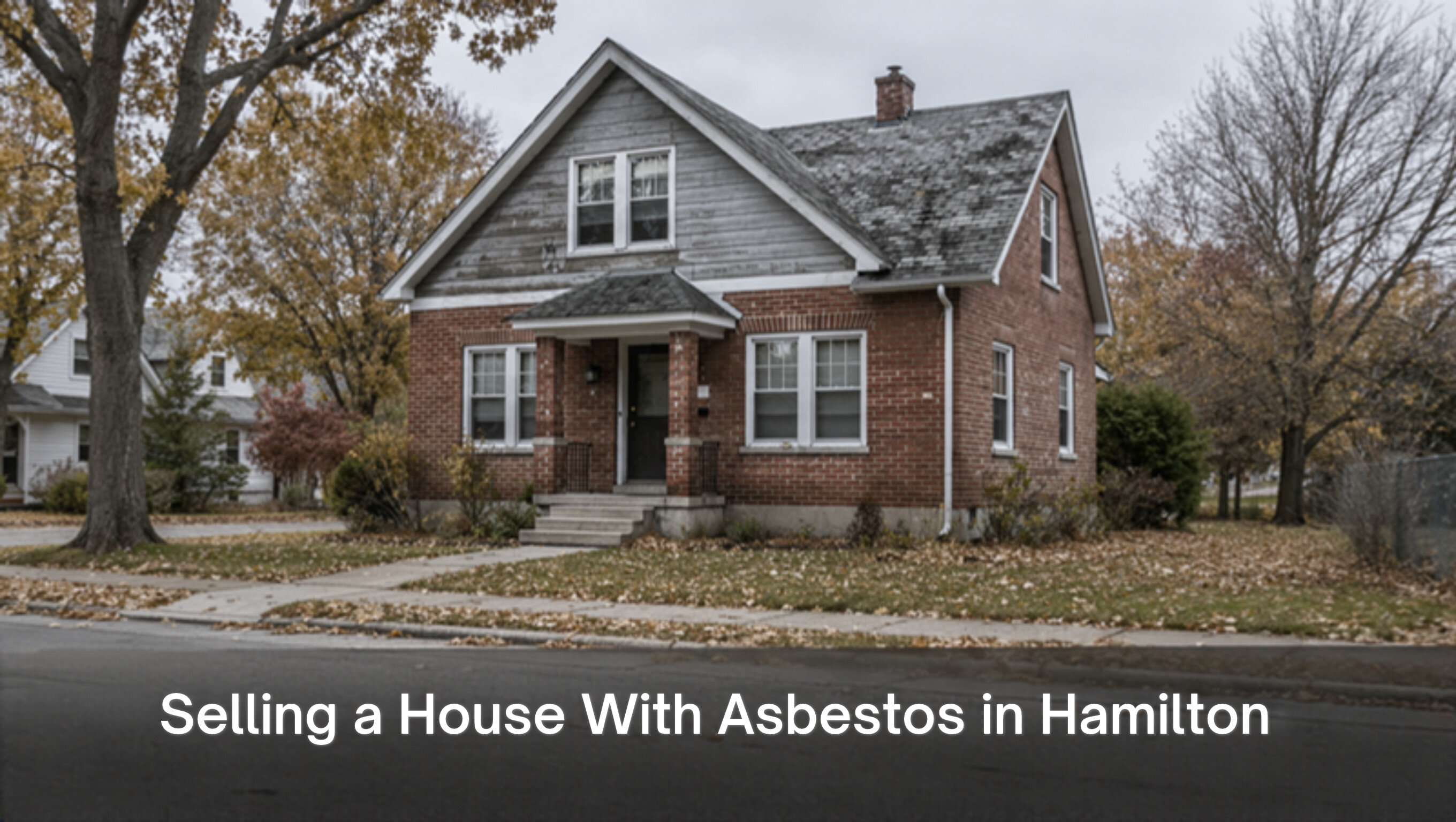
Quick answer: Selling a house with asbestos in Ontario is legal, and you do not have to remove it first. Health Canada says asbestos-containing materials pose no significant health risk when they are left undisturbed and in good condition, but Ontario sellers should not hide asbestos they know about, because a known hidden defect can lead to a claim after closing. In Hamilton, your realistic choices are to disclose and list, pay a professional to remove it, or sell the house as-is to a buyer who takes on the asbestos.
If you have just found out that the grey wrap on your basement pipes, the pebbly insulation in your attic or the old tiles under your carpet may contain asbestos, it is normal to feel stuck. You may be worried about your health, about what a buyer’s inspector will say, and about a removal bill you did not plan for. This guide explains, in plain language, how asbestos affects a home sale in Hamilton, Ontario, and what your options are.
Can You Sell a House With Asbestos in Ontario?
Yes. There is no Ontario law that stops a homeowner from selling a house that contains asbestos, and no rule that says you must remove it before you sell. Many older homes across Ontario change hands every year with asbestos-containing materials still in place.
Asbestos was a common building material for decades. Health Canada notes that before 1990 it was mainly used to insulate buildings and homes against cold and noise and for fireproofing. Canada has since banned it: the federal Prohibition of Asbestos and Products Containing Asbestos Regulations, introduced in 2018, prohibit the import, sale and use of asbestos and products that contain it, with limited exclusions (source: Health Canada, “Asbestos and your health”).
The ban stops new asbestos products from being sold. It does not require homeowners to strip old materials out of an existing house. So the real questions for a seller are practical ones: what do you have to tell a buyer, how will buyers react, and is it worth paying for removal?
Where Is Asbestos Usually Found in Older Hamilton Homes?
Much of Hamilton’s housing was built well before 1990, especially in the lower city, the east end, Crown Point, Homeside, Delta, the older parts of the Mountain, Dundas and Stoney Creek. Homes of that age can contain asbestos in several places. According to Health Canada and the Canadian Centre for Occupational Health and Safety (CCOHS), asbestos may be found in:
- Insulation around hot water pipes, tanks, boilers and older heating systems
- Vermiculite attic insulation (a loose, pebbly, grey-brown fill)
- Floor tiles and ceiling tiles
- Cement, plaster, drywall joint compound and textured surface treatments
- House siding and roofing products such as shingles, felt and tar paper
- Caulking, putty and sealants
CCOHS is clear that you cannot tell whether a material contains asbestos just by looking at it. Only a laboratory test of a sample can confirm it, and the sample should be taken by a qualified person, not scraped off by the homeowner.
What about vermiculite attic insulation?
Vermiculite deserves its own mention because it worries buyers, insurers and lenders. CCOHS explains that some vermiculite insulation sold in Canada under the name Zonolite came from the Libby Mine in Montana, where the ore was naturally contaminated with asbestos; that mine closed in 1990. Not all vermiculite contains asbestos, which is why testing matters. Health Canada’s advice if you have vermiculite is to leave it alone: do not use the attic for storage, keep children out, do not try to remove it yourself, and seal gaps such as the attic hatch and light fixtures so dust cannot fall into the living space.
Is Asbestos in Your Home Dangerous Right Now?
Usually not, as long as it is intact and nobody disturbs it. Health Canada states there are no significant health risks if asbestos-containing materials are left undisturbed, sealed behind walls and floorboards, isolated in an attic, or tightly bound in products that are in good condition.
The danger comes when fibres get into the air and are breathed in. That happens when materials are drilled, sawed, sanded, scraped, broken apart or removed during renovation or demolition, or when they are crumbling from age or water damage. Health Canada links breathing asbestos fibres to lung cancer, asbestosis and mesothelioma.
This matters for a seller in two ways. First, do not start pulling up old tiles or tearing out pipe wrap to “clean things up” before a sale; that can turn a stable material into a real hazard. Second, a buyer who plans to renovate will see asbestos as an added cost, because their contractor has to deal with it safely before any walls, floors or ceilings are opened.
Do You Have to Disclose Asbestos When Selling a House in Ontario?
If you know about it, you should disclose it, and you should get your real estate lawyer’s advice on how. Ontario follows the general rule of “buyer beware”, but that rule has limits. Ontario real estate lawyers distinguish between patent defects, which a buyer can see on a normal viewing, and latent defects, which are hidden. Legal commentary for Ontario sellers (for example, Axess Law’s guidance on selling a home with asbestos) treats known asbestos as a latent defect that should be disclosed, and warns that a seller who knows about it and hides it or lies about it can be sued after closing for the cost of fixing it and other damages.
A few points Hamilton sellers often ask about:
- You are not expected to know what you could not reasonably know. If you have never had the house tested and have no reason to suspect asbestos, you are in a different position than a seller with a lab report in a drawer. Answer questions honestly and do not guess.
- The Seller Property Information Statement (SPIS) is generally voluntary in Ontario. It is a form from the Ontario Real Estate Association. Choosing not to fill it in does not remove your responsibility for a hidden defect you know about.
- Writing “as is” is not a shield for concealment. Selling as-is means the buyer accepts the condition of the house. It does not make it safe to hide something you know is there. The cleanest as-is sale is one where the buyer has been told about the asbestos and agrees to take it on.
- Do not make promises you cannot back up. If a buyer asks you to confirm the home is asbestos-free and you do not know, say so, and let your lawyer review any wording before you sign.
Every situation is different, so speak with an Ontario real estate lawyer before you sign a listing agreement or an Agreement of Purchase and Sale. The Law Society of Ontario’s referral service can help you find one. The same honesty-first approach applies to other hidden issues in older homes, such as knob-and-tube or aluminum wiring and renovations done without a permit.
Should You Remove Asbestos Before Selling a House in Ontario?
Not automatically. Removal makes sense in some cases and is wasted money in others. Before you decide, it helps to understand how the work is regulated.
Ontario Regulation 278/05, made under the Occupational Health and Safety Act, sets the rules for asbestos on construction projects and in building repair. It sorts asbestos work into three categories by risk:
- Type 1 (lowest risk): for example, removing a small number of intact ceiling tiles or other non-crumbling material without breaking it.
- Type 2 (medium risk): for example, removing one square metre or less of crumbling (friable) material, or removing pipe insulation using a glove bag.
- Type 3 (highest risk): for example, removing more than one square metre of friable material, which requires full enclosures and the strictest precautions.
The regulation does not apply to the owner of a private residence that the owner or the owner’s family lives in. That exemption is for you as the owner; the contractors and workers you hire still have their own duties under Ontario’s health and safety law, enforced by Ministry of Labour inspectors. In practice, that means a reputable abatement company will follow the Type 1, 2 or 3 procedures in your house, and the price reflects it. Both Health Canada and CCOHS advise homeowners not to remove asbestos themselves and to hire a qualified removal specialist; CCOHS also says painting over asbestos is not a proper way to seal it.
Removal before selling tends to make sense when the material is damaged or crumbling, when it is a small, contained job such as a short run of pipe wrap, or when you are listing a well-kept home and want to remove the one item most likely to scare a buyer. It tends not to make sense when the asbestos is widespread, when the house needs other major work anyway, when you do not have the cash to pay a contractor up front, or when you are on a deadline. Always get written quotes from more than one qualified, insured contractor, and ask for the lab results and a clearance report to keep for the buyer.
How Does Asbestos Affect What Buyers Will Pay in Hamilton?
Asbestos narrows your pool of buyers and gives the ones who remain a reason to negotiate, and that matters more in a market where buyers have choices. According to Wowa’s Hamilton housing market report (updated November 5, 2026, using REALTORS Association of Hamilton-Burlington and CREA data), the average sold price in Hamilton in October 2026 was $724,461, down 7.3% from a year earlier. Homes took an average of 40 days to sell, and there were 4.8 months of supply, which Wowa describes as a balanced market.
Borrowing costs have also moved. On October 28, 2026, the Bank of Canada raised its policy rate by a quarter point to 2.50%, its first increase since 2023, as reported by RBC and nesto. Higher rates make buyers more careful about taking on a house with an unknown repair bill.
With that backdrop, here is what Hamilton sellers with asbestos can expect on the open market:
- Home inspections will flag it. Inspectors routinely note suspected asbestos on pipe wrap, vermiculite in the attic and older floor tiles, and recommend testing.
- Buyers ask for a price reduction or a holdback. Many will get their own abatement quote and try to take that amount, or more, off the price.
- Financing and insurance questions can come up. Some insurers and lenders ask about vermiculite and asbestos, and a buyer who cannot get comfortable answers may walk away during the conditional period.
- Deals can fall apart late. A sale that collapses after an inspection costs you weeks, and the next buyer will ask why the home came back on the market.
None of this means your house will not sell. It means you should go in with realistic expectations and a plan for the inspection conversation.
What Are Your Options for Selling a House With Asbestos in Hamilton?
You have four honest options. The right one depends on your timeline, your budget and the overall condition of the house.
1. Remove it, then list with a real estate agent
Best when the asbestos is limited, the rest of the home shows well, and you have the money and time to do it properly. You keep the widest pool of buyers and can hand over a clearance report. The trade-off is the up-front cost and the weeks it adds before you can list.
2. Test, disclose and list as it is
If the material is intact, you can have it tested, disclose the results and price the home accordingly. This is often a good fit for a tidy home in a sought-after Hamilton neighbourhood where the asbestos is one known, quantified issue. Expect inspection conditions and some negotiation. A good local agent will tell you how similar homes have been received.
3. List without testing and deal with it when it comes up
Some sellers simply list an older home and wait to see what the buyer’s inspector says. This is allowed if you truly do not know, but it leaves you negotiating under pressure in the middle of a deal, and you still must not hide anything you do know.
4. Sell as-is directly to a cash buyer
If you do not want to test, remove or negotiate over asbestos, you can sell the house in its current condition to a buyer who is not relying on a mortgage approval or an insurer’s sign-off. As local buyers, we buy houses in Hamilton with asbestos, vermiculite and other older-home issues, and we take on the testing and professional removal after closing. The trade-off is price: a direct offer reflects the work the buyer is taking on, so it will usually be lower than what a fully remediated home could fetch on the open market. For many owners, the certainty and the saved repair costs make up the difference; for others, listing is the better choice, and we will say so.
Ready to sell your house fast in Hamilton?
Or call us directly: 647-800-4508
How Hamilton House Buyers Looks at a Home With Asbestos
We look at older Hamilton homes every week, so suspected asbestos does not surprise us and does not end the conversation. Here is how we approach it:
- We do not ask you to test or remove anything. If the home was built before 1990, we assume some materials may contain asbestos and plan for it.
- We look at where it is and what shape it is in. Intact pipe wrap in a basement is a very different job from vermiculite across a whole attic or crumbling material that has already been disturbed.
- We budget for qualified abatement. Any removal after we buy is done by trained contractors following Ontario’s Type 1, 2 and 3 procedures, and our offer accounts for that cost so you are not asked to pay for it.
- We want you to tell us what you know. If you have a test result or an old inspection report, share it. It helps us give you an accurate offer and it protects you.
- The sale closes through lawyers. You choose your own Ontario real estate lawyer, who reviews the Agreement of Purchase and Sale and handles the closing, the mortgage payout and your proceeds.
There are no showings, no cleaning and no repair requests. If you would like to see what you would actually walk away with either way, our guide to closing costs for sellers in Ontario walks through the usual deductions.
Steps to Take If You Think Your House Has Asbestos
- Do not disturb it. Leave suspect materials alone, and stop any renovation work in that area.
- Write down what you know. Note where the material is, its condition, and any past reports, quotes or test results.
- Decide whether to test. Health Canada recommends hiring a professional to test before renovating. If you plan to list, a test gives you facts to disclose instead of a question mark.
- Talk to an Ontario real estate lawyer about what to disclose and how to word it.
- Compare your options side by side. Get an abatement quote, ask an agent for a realistic list price and timeline, and get an as-is offer. Then compare what you would net, and how long each path takes.
- Choose the path that fits your situation, not the one someone is pushing you toward.
Frequently Asked Questions
Is selling a house with asbestos in Ontario legal?
Yes. Ontario does not prohibit selling a home that contains asbestos, and you are not required to remove it first. You should, however, be honest about asbestos you know about and get advice from a real estate lawyer on disclosure.
Do I have to tell buyers about asbestos in my Hamilton house?
If you know it is there, the safe answer is yes. Ontario legal commentary treats known asbestos as a hidden (latent) defect, and a seller who conceals it can face a claim after closing. Ask your lawyer how to disclose it properly in your agreement.
Can I remove asbestos myself before I sell?
Health Canada and CCOHS both advise against it. Disturbing asbestos is what releases fibres into the air, and CCOHS states that removal by a homeowner is not safe. Hire a qualified, insured removal specialist.
Does vermiculite insulation always contain asbestos?
No. CCOHS notes that not all vermiculite sold in Canada contains asbestos; the concern is mainly with product from the Libby Mine in Montana, sold as Zonolite. Only laboratory testing can tell you, so treat it as suspect and leave it undisturbed until it is tested.
Will a buyer be able to get a mortgage or insurance on a house with asbestos?
Often yes, but it depends on the lender, the insurer, and the type and condition of the material. Some ask extra questions about vermiculite or damaged asbestos, which can slow down or end a conditional deal. A cash purchase avoids that step.
How much does asbestos lower a home’s value?
There is no fixed figure. Buyers generally look at the cost of professional removal plus a cushion for the unknown, and the effect is bigger when the material is widespread or damaged. Written quotes from qualified contractors are the best way to put a real number on it.
Will Hamilton House Buyers buy a house with asbestos or vermiculite?
Yes. We buy homes in the City of Hamilton in as-is condition, including homes with suspected or confirmed asbestos, and we handle testing and removal after closing. We cannot promise a specific price or closing date before seeing the property, but the offer is free and there is no obligation.
Final Thoughts
Finding asbestos in your home is stressful, but it is a common and manageable problem in older Hamilton houses. Left alone and in good condition it is generally not an immediate danger, it does not stop you from selling, and you have more than one way forward. Be upfront about what you know, do not disturb it, get proper legal advice, and compare the real numbers for removing and listing against selling as-is. If you decide you would prefer to hand the problem to someone else, we are happy to take a look and give you a straight answer.
Ready to talk? Call 647-800-4508 or fill out the form below, and we will get back to you with a no-pressure cash offer for your Hamilton, Ontario home.